
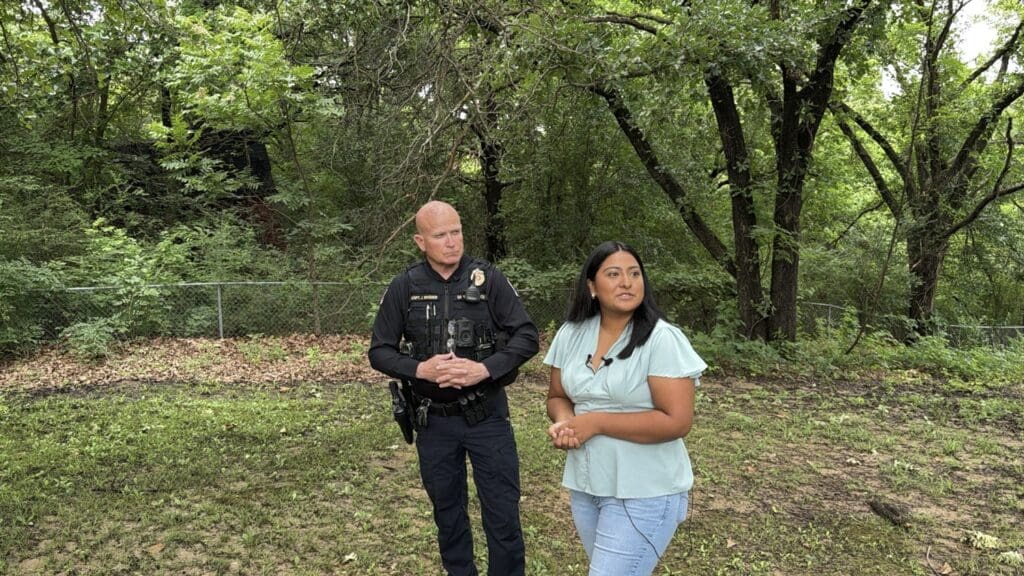
On Wednesday afternoon, Monserrat Aguirre met with Sapulpa Police Captain Jim Madden, as they recounted the details of the incident that ended at the literal hill that Aguirre was afraid she might die on.

In 2014, 8-year-old Monserrat Aguirre was kidnapped from an east Tulsa playground by 35-year-old Michael Slatton. Slatton was from Claremore, a registered sex offender, and at the time, had 10 different felony counts on his record, according to reporting by The Tulsa World.
An Amber Alert went out, but Slatton evaded police for about eight hours before being spotted in Sapulpa at the Whataburger drive-thru. When a Creek County sheriff’s deputy confronted Slatton, he tried to drive off, dragging the deputy and tossing him into traffic. Shortly thereafter, Slatton was surrounded and taken into custody.
But the car he was driving was empty. Officers of several law enforcement agencies spread out over a wide area to begin searching. Among them was Sapulpa officer Jim Madden, a sergeant at the time.
“Maybe it’s the cynical thing of being a police officer and seeing all the bad things that we deal with,” Madden says. “I didn’t think I was going to find her alive. I thought I was looking for a body the whole time.”
On the area west of Hickory Street known as “Ford Hill,” Madden and other officers were searching a parcel of land that had some houses, but also a lot of woods, and in his mind, the perfect place to stash an 8-year-old child.
“He just took me out of his trunk and threw me here,” Aguirre says, gesturing to the ground where she stood. “I had no clue where I was, and I was too scared to do anything or approach anyone, so I just sat there… It’s such a confusing thing for an eight‑year‑old, not knowing what was being done to you and where you were going, who you were with.”
Madden decided to continue to search the area, even with others
“I said, well, I’m going to stick around here and look some more, because I have chased suspects all over this field,” he says. “I knew there was a lot of hiding spots and a lot of wooded areas that you could walk right past somebody and wouldn’t see them… something just kept driving, you know, to look a little bit further and a little bit further, and then it happened.”
Just steps ahead of him, Madden spotted a flash of orange. It turned out to be a sleeping bag.
“It’s not usual to see something bright orange, you know, on the ground… it wasn’t hunting season or anything,” he says. “I’d just seen a small piece of it when I [came] off the hill, and then when I started walking down to it, I could tell that it was a sleeping bag, and you know, my heart was already pounding.”

Madden told Aguirre, “You weren’t moving or anything… I went to go open up the head end of the sleeping bag… when I opened it up, I couldn’t tell you were breathing or anything, and so I reached up to check your pulse, and when I did, you opened your eyes, and you immediately just started wanting to tell me everything.”
For Madden, that moment changed everything.
“When she opened her eyes and looked at me. I was 10 feet tall at that time,” he says. “It was the most incredible feeling in the world… it was a miracle that you were all right, and that we were able to get to you in time… it was probably the biggest thing that ever happened in my career.”
Slatton was eventually convicted and sentenced to 120 years in prison.
Madden has stayed in touch with Aguirre over the years, even attending her graduation. Seeing her back on the hill, he doesn’t just see a victim; he sees what happened afterward.
“Her whole life is a miracle,” he says. “She has done so well, and she, she’s a person that stands out for all victims of violence and things of that nature, and how well that she’s turned her life to be such a great thing.”
Aguirre just graduated from TCC in May is pursuing a bachelor’s and masters in social work. She says her experience gave her the desire to help others through their own challenges.
“I keep on looking at this tree, because… I remember it very well now that I think about it,” Aguirre says, her eyes fixed on a landmark from that night. “There are a lot of negative memories attached to this place, but I’d rather not use it as a weakness… I would use it as a strength.”
Asked what message she wants people to take from her story, Aguirre doesn’t hesitate.
“I would say to never be quiet, always speak up,” she says. “Being quiet just hurts so much; keeping everything inside and feeling as if you’re not able to share anything. So never be afraid to speak up, and always share your story—your story, no matter what you go through, holds power.”
Watch Lori Fullbright’s interview with Montserrat Aguirre on YouTube.


