

Youth Services of Creek County recently partnered with the Office of Juvenile Affairs to bring the “Connecticut Model: Effective Police Interactions with Youth for Positive Interactions with Oklahoma Youth Project” CLEET-certified class to the County’s law enforcement officers.”
YSCC Executive Director Erin Brook told Sapulpa Times, “We were excited to introduce this training to the community.” She explains that “law enforcement officers are often on the front lines when working with youth in crisis. This training taught the importance of connecting with youth and best practice techniques when working with youth in crisis…If we want a successful community we must all work together using best practices to help our youth achieve success.”
According to the Kids Count Data Center, 24% of Oklahoma children ages 3-17 have been diagnosed with a behavioral or mental health diagnosis, and 220 Creek County children were abused or neglected by a parent or someone in charge of their care in 2019. Their interactions with LEOs are of utmost importance to their well being.
The instructors were Andre Parker and Jill Riggiero of the OJA. There were participants from the Sapulpa Police Department, the Creek County Sheriff’s Office, YSCC, the OJA, and other entities.
“This is [largely] about families in our jurisdictions whose risk factors we know,” said Riggiero. Local organizations should “collaborate together to discuss specific needs and issues.”
Brook said that there are existing groups that do this, such as the Creek County Community Partnership, CASA, and YSCC’s Care Teams, and that there are also some groups other communities have that could be implemented here, such as transitional living programs.
“There’s a lot more we can be doing; there are a lot of gaps,” said Brook. “We need more representation” for abused and neglected children. “The police can be involved in our care teams, for example. Detective Amy Nichols always comes” to those meetings.
The training covered, among multiple other topics, the importance of non-enforcement or non-authoritative roles for LEOs to embody where these kids can connect with them on a more equal level. This could be as a mentor, coach, volunteer, or through school events or a citizens youth program. “Working in non-enforcement roles can help reverse negative youth attitudes toward police greatly,” said Riggiero.
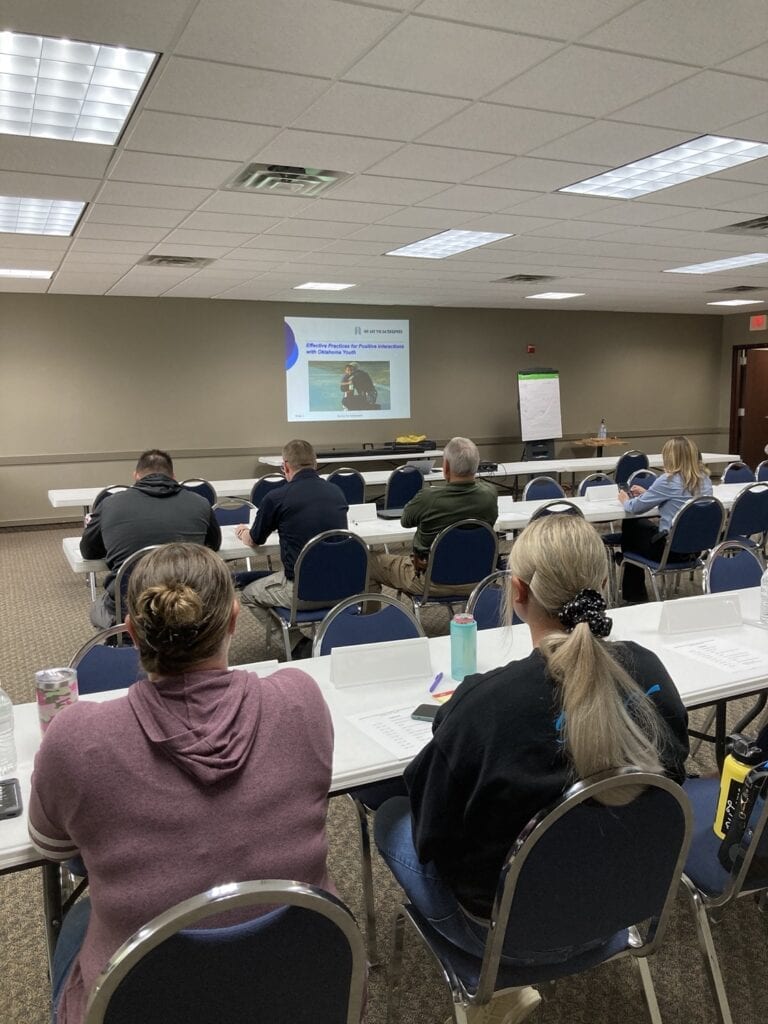
She asked those in attendance for suggestions on ways they could interact with children and teenagers while on duty and off. She also had a bevy of them from kids themselves, which included: “be approachable, get out in the community more, stop and chat, and give [kids] a voice.”
Riggiero also asked that officers “build rapport, explain why you arrested them, help them, get involved, listen to their ideas. You can call a kid to see how things are going—more in depth conversations are crucial. This shows you’re not just going through the motions with them and that you really care.”
Additionally, the instructors said, “you cannot discount the importance of connecting with families and involving parents. Strengthening families is the goal,” so our youth can stay on the paths that will lead them to their highest good.
Finally, the collaboration between police and all other child-serving agencies is critical. “It’s important to know what everyone’s roles are,” said Riggiero. “You will get better results. Why wait until it gets dire or crimes have been committed to do this? Let’s agree to do this on a regular basis to try to prevent these things from happening in the first place.”
“This was an incredible training that I hope to bring back to Sapulpa so teachers, superintendents, and even more law enforcement officers can be present,” said Brook.