

In the movie “Little Shop of Horrors,” a young florist talks to a man-eating plant named Audrey 2 who talks back. In another movie, “The Happening,” plants and trees attack mankind in response to pollution and release neurotoxins that cause people to commit suicide.
While these sci-fi scenarios seemed far-fetched, scientists have discovered that trees do communicate with each other and mount defenses against perceived threats.
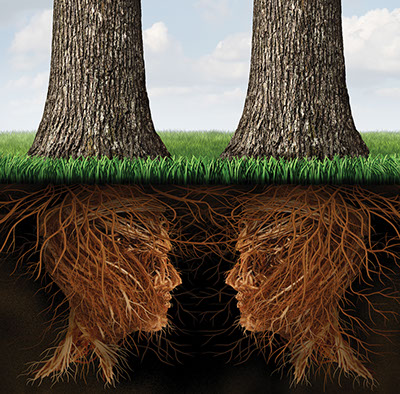
In 1997, ecologist Suzanne Simard, while conducting research for her doctoral thesis, discovered that trees speak to each other to convey their needs and transfer necessary nutrients via tiny threads of fungi buried in the soil. This communications network has been referred to as the “Wood-Wide Web.”
Using radioactive isotopes of carbon she ascertained that Paper Birch and Douglas fir trees interacted using an underground network.
Her subsequent research at the University of British Columbia sought to understand how trees send warning signals about environmental change, look for relatives, and send their nutrients to neighboring plants before they die. She has identified hyperlinked “hub trees,” as she calls them in scientific papers, or “mother trees,” in everyday parlance.
Many species of trees, including Paper Birch and Douglas fir, form what can be considered a symbiotic relationship with the underground fungi. These fungi are beneficial to the trees and through this alliance, the fungus, which can’t photosynthesize, searches the soil. The fungal matrix sends mycelium, or threads, throughout the soil, absorbs nutrients and water, especially phosphorus and nitrogen, then bring them back to the tree, and exchanges those nutrients and water for photosynthate (a sugar or other substance made by photosynthesis from the tree.
Peter Wohlleben, a German forester who manages a forest in the Eifel Mountains in western Germany, which serves as a nature reserve, where he lives in a cabin with his wife, Miriam, near the remote village of Hümmel.
Wohlleben is the author of “The Hidden Life of Trees: What They Feel, How They Communicate,” and a self-proclaimed tree whisperer who has devoted his entire life to the study and care of trees. He succinctly conveyed his scientific knowledge through his book in a way the general public can understand.
The latest research, conducted at prominent universities in Germany and across the globe, confirms what he has long suspected from close observation in this forest: trees are far more alert, social, sophisticated—and even intelligent—than we thought.
In order to communicate through the network, trees transmit chemical, hormonal and slow-pulsing electrical signals.
Edward Farmer, Professor of Plant Molecular Biology, at the University of Lausanne in Switzerland, has been studying the electrical pulses that trees send out and has identified a voltage-based signaling system that appears remarkably similar to animal nervous systems.
Alarm and distress appear to be the main topics of “tree talk,” although Wohlleben wonders if that’s all they discuss “What do trees say when there is no danger and they feel content? This I would love to know.” Monica Gagliano, Associate Research Professor, at the University of Western Australia has compiled evidence that some plants may also emit and detect sounds, specifically, a 220-hertz crackling noise in the roots, that can not be heard by humans.
As well as below-ground communication, Trees also communicate through the air, utilizing pheromones and other scent signals. Wohlleben’s favorite example occurs on the savannas of sub-Saharan Africa, where the wide-crowned umbrella thorn acacia is the representative tree. When a giraffe starts chewing acacia leaves, the tree senses the injury and emits ethylene gas as a form of distress signal. Once this gas is detected, neighboring acacias start sending tannins into their leaves. In certain quantities, these defensive compounds can cause illness or death in large herbivores.
Trees can detect scents through their leaves, which can be construed as a sense of smell. They also have a sense of taste. When elms and pines are being attacked by leaf-eating caterpillars, When caterpillar saliva is detected, they release pheromones that attract parasitic wasps. These wasps lay their eggs inside the caterpillars, the wasp larvae then eat the caterpillars from the inside out.
A joint study from the German Centre for Integrative Biodiversity Research and Leipzig University demonstrates that trees know the taste of deer saliva. “When a deer is biting a branch, the tree brings defending chemicals to make the leaves taste bad,” Wohlleben says. “When a human breaks the branch with his hands, the tree knows the difference, and brings in substances to heal the wound.”
“Mother trees” assist neighboring trees by sending them nutrients, and when the neighbors are struggling, mother trees “sense” their distress signals and boost the flow of nutrients.
Are trees sentient creatures? The answer is at this point we just don’t know.