
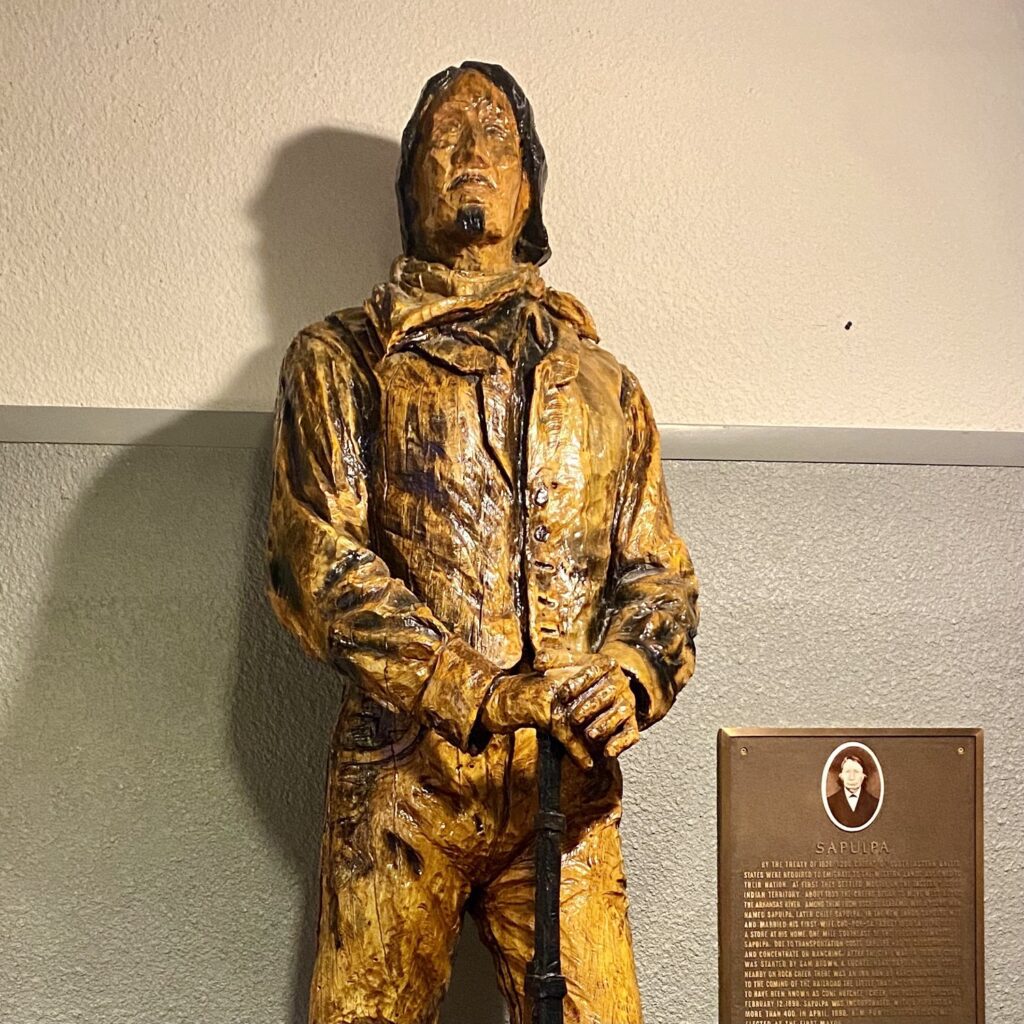

A 10-ft tall wooden statue of Chief Sapulpa was moved last week from its longtime home at Sapulpa City Hall, where it has stood since it was completed in 1990, to the front room of the Sapulpa Historical Society Museum.
“[Sapulpa Fire] Chief David Taylor called me at about 10 a.m. on Wednesday morning,” said Museum Curator Rachel Whitney, “and he showed up [a little later] with at least 8 firefighters from station 1 and 2.” The crews carefully moved the statue against the wall, where it’s bound to be one of the first things that catches the eye of anyone who walks in.
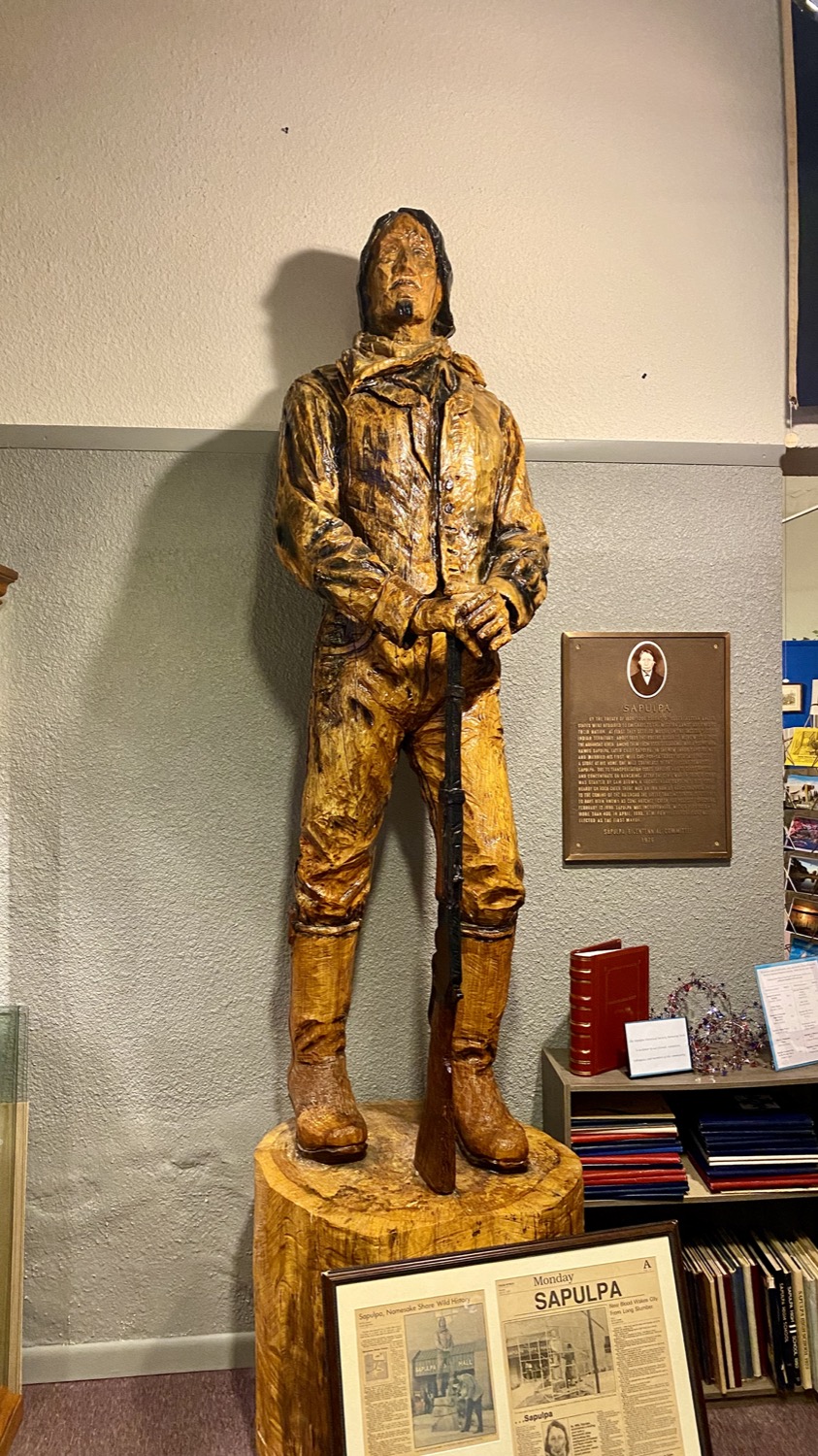
Sapulpa City Manager Joan Riley said the move was part of a decision to get the Chief more exposure. “We had no way to clean or preserve the statue,” she says, adding that she believes “there will be more visitors and history enthusiasts to view the work of art located at the museum.”
The large statue was carved by Chainsaw Artist Clayton Coss, and was made from a 90-year-old pecan tree removed from Polecat Creek. It was the second time in 100 years that wood would play an important role in remembering Sapulpa, and the source of the tree is as important to the statue as it is to the origin of the town that bears its name.
Chief Sapulpa—a man who wasn’t actually a chief, or named Sapulpa—was a Creek Indian from Alabama who evidently had an issue with authority, according to late Sapulpa historian Jim Hubbard. Allegedly born in 1824 into the Kashita tribe of Muscogee (Creek) Indians, Chief Sapulpa was orphaned at a young age and raised by his two uncles, who taught him two important things: “rudimentary English, and to resist the white man, no matter what,” Hubbard said in a 1990 Tulsa World story commemorating the carving of the statue.
When Creek and Yuchi Indians were forced to relocate to northeastern Oklahoma through the Trail of Tears, Sapulpa—whose name was listed in his Civil War discharge papers as “Sapulcher”—resisted and stayed, defying the orders of the white man and his government.
Hubbard said that by the 1840s, Sapulpa was tired of fighting, and decided to move to be nearer to his tribe. He established a trading post and blacksmith shop near an intersection of Polecat and Rock creeks. Over time, he became successful selling coffee, sugar, tobacco and other goods to settlers and traders in the area.
At some point, Sapulpa’s feelings of animosity toward the white man cooled; when the Atlantic & Pacific Railroad extended its line from Red Fork in 1886, the rail yard was called Sapulpa Station, because of the friendly reputation the man had with the railroad workers. Sapulpa himself was the first passenger to ride the train into Sapulpa Station. He died the next year, in 1887. Sapulpa’s first post office was established on July 1, 1889, and the town was incorporated on March 31, 1898.
But why was wood, which was not one of the primary resources for which Sapulpa became known, so important in its start?
That first railroad spur created by the Atlantic & Pacific was created to transport wood after a logging company bought and began chopping a large stand of black walnut trees south of town. Some of the wood reportedly found its way to England and was later sold to Germany, where it was used to make gunstocks for World War I.
Thirty years after the carving of the statue, it now sits, preserved and protected, in a building filled with many other artifacts that tell the story of this bustling town that began as a trading post near a creek. The statue and all other artifacts can be visited by the public during the museum’s open hours, Tuesday through Saturday, 10:00 am to 3:00 pm. The Sapulpa Historic Society Museum is located at 100 E. Lee Ave.